Why AI Agents Are the Next Evolution of Business Software
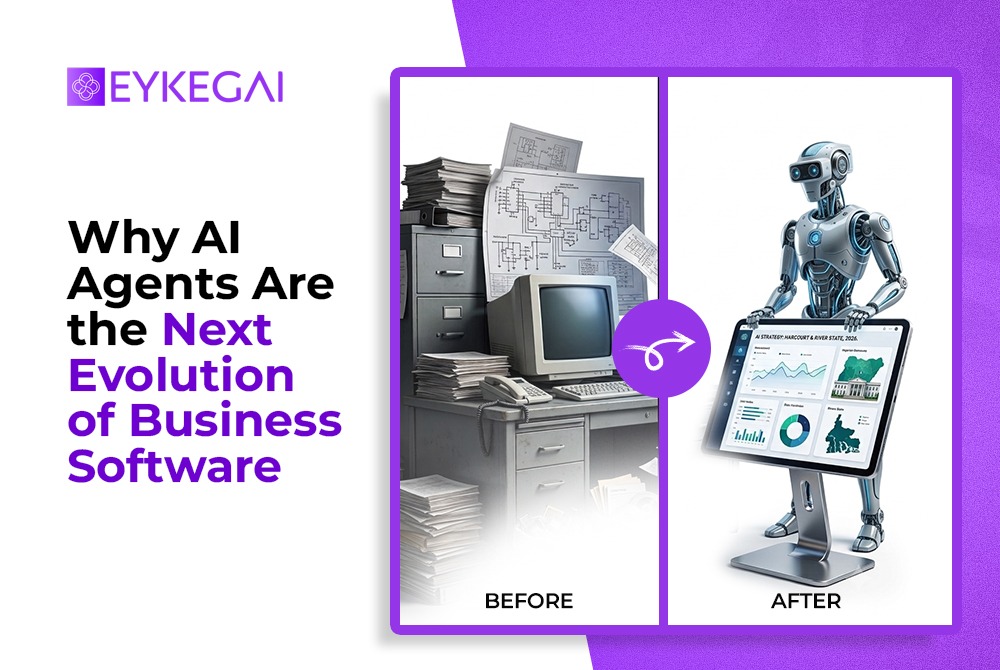
For years, business software has helped organizations store information, manage processes, and automate repetitive tasks. Enterprise Resource Planning (ERP) systems, Customer Relationship Management (CRM) platforms, and other business applications have made operations more organized and efficient.
But business software is entering a new phase.
The next generation of enterprise technology is not simply about automating what employees already do. It is about software that can understand context, respond to requests, provide recommendations, and take action.
This is where AI agents come in.
From Automation to Intelligence
Traditional business automation follows predefined rules.
If a certain condition is met, the system performs a specific action. This has helped businesses reduce manual work, but it still requires people to define the process and manage exceptions.
AI agents introduce a different approach.
Instead of simply following fixed instructions, an AI agent can interpret a user’s request, access relevant information, determine the steps required, and assist with completing the task.
For example, traditional software may require an employee to navigate several screens to create a purchase request. An AI agent could understand a natural-language request, retrieve the relevant information, guide the user through the process, and potentially execute the required steps.
The difference is subtle but significant: automation follows instructions; intelligent systems can help determine what needs to happen next.
Why Context Matters
One of the biggest limitations of traditional software is that users have to understand how the system works.
They need to know where information is stored, which menu to open, which workflow to follow, and what steps are required to complete a task.
AI agents can reduce this complexity by allowing users to interact with business software conversationally.
Instead of asking, “Where do I create a purchase requisition?”, a user can simply state what they need to accomplish.
The agent can then use available business information and knowledge to provide relevant guidance or initiate the appropriate workflow.
This creates a more natural relationship between people and enterprise software.
AI Agents Can Become Part of the Workflow
The real potential of AI agents goes beyond answering questions.
They can become an active layer within business operations.
Consider a typical workflow involving multiple steps, departments, and approvals. Traditionally, employees would move between different parts of an ERP system, check information, enter data, and wait for processes to progress.
An AI agent can help bring these activities together.
It can assist users in navigating workflows, retrieve information from the organization’s knowledge base, and support multi-step processes. This reduces the amount of time employees spend figuring out how to use the software and allows them to focus more on the outcome they are trying to achieve.
From Systems of Record to Systems of Action
Traditional enterprise software has largely been built around the idea of being a system of record.
It stores transactions, employee information, customer records, financial data, inventory information, and other critical business information.
AI agents introduce the possibility of turning these systems into systems of action.
The software doesn’t just hold the information. It can use that information to help users make decisions and execute tasks.
This is particularly powerful when AI is connected directly to ERP systems, because the agent can operate within the same environment where business processes and data already exist.
The Impact on Employees
AI agents aren’t necessarily about replacing employees. Their immediate value lies in removing friction from everyday work.
Employees spend a significant amount of time searching for information, navigating systems, preparing reports, answering routine questions, and completing repetitive processes.
An intelligent agent can take on some of this workload or make it significantly easier to complete.
This can be especially valuable for new employees.
Instead of relying entirely on formal training or asking colleagues for help every time they encounter an unfamiliar process, employees can interact with an AI assistant that understands the organization’s systems and documentation.
The result is a more accessible and responsive working environment.
What Comes Next?
AI agents are still an emerging technology, but their direction is clear.
Business software is moving from systems that require users to understand the software toward systems that can better understand the users.
The future enterprise platform may not be defined by how many features it has or how many menus employees can navigate. Instead, it may be defined by how effectively it can help people accomplish their goals.
For businesses, this shift presents an opportunity to rethink how employees interact with technology.
The question is no longer simply:
“What can our software automate?”
It is becoming:
“What can our software understand, decide, and help us accomplish?”
AI agents are bringing business software closer to that future—where technology doesn’t just support the workflow, but actively works alongside the people using it., and productivity work hand in hand.